
During the renovation of the medieval parish church of Cluj (completed in 2021), almost two thousand books kept in St Michael’s church (picture below) were transferred to the newly established archive of the Roman-Catholic Church. Until recently, almost nothing was known about these books, of which no catalogue exists.

The inventory of the collection, drafted on 18 December 1963 by canon Béla Baráth, then priest of St Michael’s church, lists 1838 printed books, and 52 manuscripts. The diligence of Dr Emőke Nagy, the archivist, has recently uncovered the only medieval manuscript in the collection (Nicholas of Lyra, Postilla super Evangelia, 1470), which had been kept separately for a while in the vicar’s office.

Since the scholarly community ignores the existence of this manuscript[6], I am happy to signal it here. The paper manuscript measures 405 x 290 mm, and counts 275 leaves. Like many of the library’s incunabula, this is a chained book (liber catenatus), with a perfectly preserved Gothic binding. It has a few decorated initials (red and blue flourished initials, and simple lombards), and many empty reserved spaces. Nicholas of Lyra’s commentaries to the four Gospels are completed with additions by Paul of Burgos (additiones Pauli Burgensis episcopi).

Cluj, Arhiva parohiei romano-catolice Sf. Mihail, MS 52 (323c?), f. 1r.
The manuscript has a dated colophon on f. 275v, which reads: Expliciunt addiciones ad postillam Magistri Nicolay de lira super quatuor ewangelistas. Anno domini 1470.
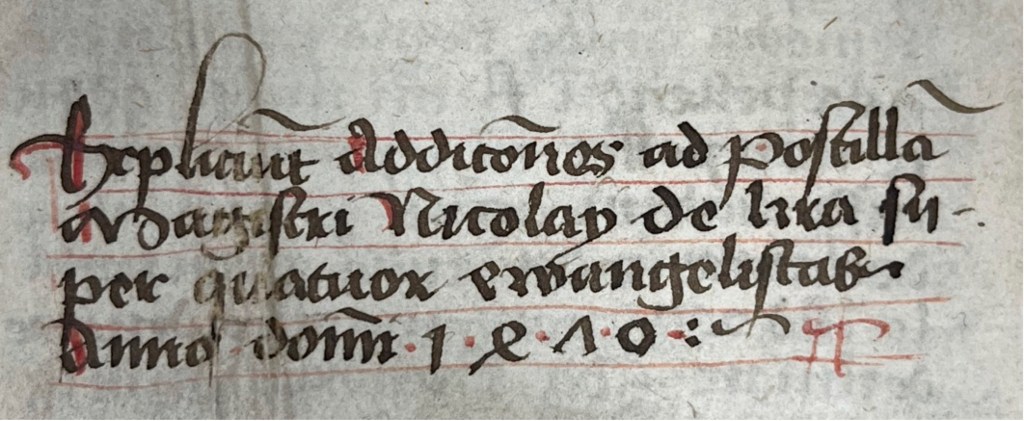
Cluj, Arhiva parohiei romano-catolice Sf. Mihail, MS 52 (323c?), f. 275v.
Another scribal formula at the end of the commentary to Mark shows that the manuscript was copied by a German-speaking scribe: Explicit exposicio literalis magistri Nicolai de lira super Marcum. (S)wie fro ich was do ich sprach. Deo Gracias. (f. 121v).

Cluj, Arhiva parohiei romano-catolice Sf. Mihail, MS 52 (323c?), f. 121v
Coming across Nicholas of Lyra’s Postilla instantly rang a bell, and I remembered having seen another copy of this work in the Batthyaneum Library in Alba Iulia. Most strikingly, this volume (MS. I.12) contains the commentay to the following texts of the New Testament (Acts of the Apostles, Epistles, Revelation). Moreover, the manuscript was copied in 1471, and has exactly the same size as St Michael’s book (405-410 x 290 mm).

Alba Iulia, Biblioteca Batthyaneum, MS I.12, f. 328v.
I knew that the bishops of Transylvania, from Batthyány himself to Gusztáv Majláth in 1913[8], were in the habit of transferring medieval manuscripts from parishes to the great library in Alba Iulia. Could this be another instance of a work split between Cluj and Alba Iulia?
All one had to do was to compare the two volumes. Although they were copied by different scribes, the two manuscripts were certainly bound in the same workshop, as the iron fittings and some of the stamps on the blind-tooled binding demonstrate. Although the Alba Iulia manuscript has lost its chain, and the Cluj book has lost its label on the front cover, they also had these elements in common. Moreover, some of the same tools were used to decorate the bindings of various incunabula from Saint Michael’s collection, which demonstrates that the book in Alba Iulia was taken there from Cluj, at a moment which I must still identify.
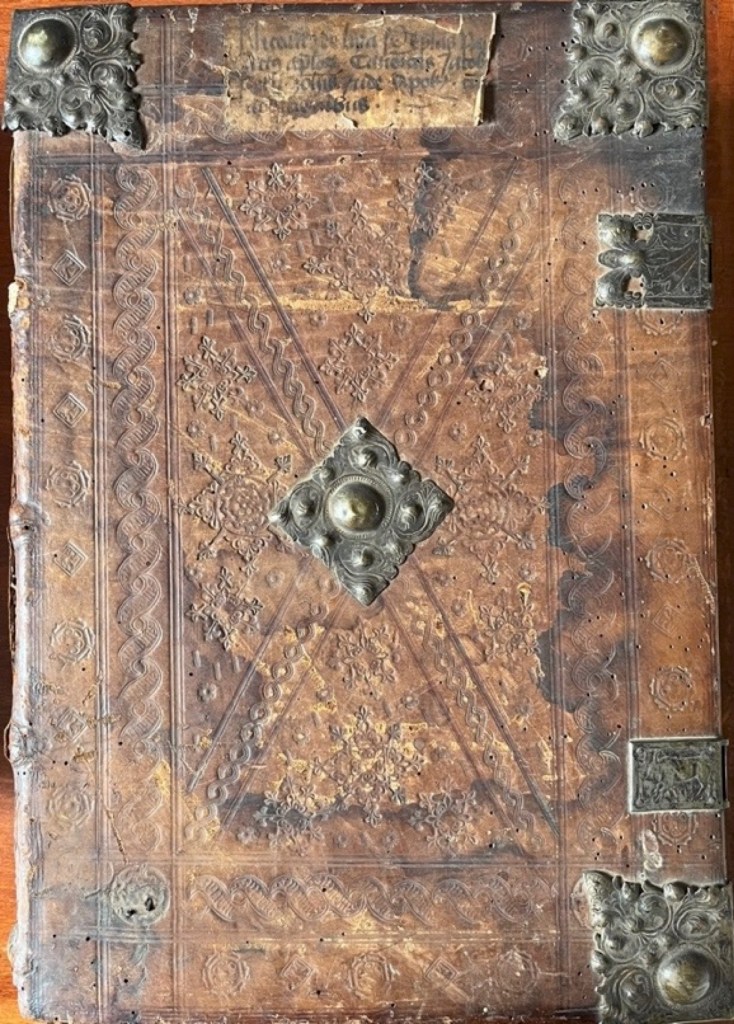
Binding of Alba Iulia, Bibl. Batthyaneum, MS I.12

Binding of Cluj, Roman-Catholic Archive, MS inv. 52.
A future study will provide more information.
Adrian Papahagi

Quote as: Adrian Papahagi, ‘Exciting Discovery: Medieval Manuscript Emerges in Cluj’, at https://centrulcodex.com/2023/12/04/exciting-discovery-medieval-manuscript-emerges-in-cluj/
[1] Elena-Maria Schatz, Robertina Stoica, Catalogul colectiv al incunabulelor din România, Bucharest: CIMEC, 2007, nrs [B-120], [G-21], [G-42], [H-29], [M-71], [T-17].
[2] Thanks to Dr György Jakubinyi, former Roman-Catholic Archbishop of Alba Iulia, Dr Gergely Kovács, current Archbishop, and Dr Rita Magdolna Bernád, Archivist of the Roman-Catholic Diocese of Alba Iulia.
[3] Adrian Papahagi, Books from Lost Libraries: The Medieval Dioceses of Cenad, Oradea, and Transylvania, Cluj: Presa Universitară Clujeană, 2023, pp. 114-115, 136.
[4] Ibid, p. 114.
[5] Inventarul Bibliotecii Bisericii romano-catolice Sfîntul Mihail din Cluj: Cărți, Manuscrise – typewritten document.
[6] This includes our recent work, A. Papahagi, A. C. Dincă, with A. Mârza, Manuscrisele medievale occidentale din România. Census, Iași: Polirom, 2018.
[7] For instance, Frankfurt am Main, Universitätsbibliothek, Ms. Praed. 91, ff. 62r, 129r (Frankfurt?, 1475-1498); Leipzig, Universitätsbibliothek, Ms. 1590, f. 136r (Nürnberg, c. 1460-1465); Augsburg, Staats- und Stadtbibliothek, 2° Cof. 160, f. 104r (Schwaben, 1447); Augsburg, Universitätsbibliothek, Cod. III.1.2° 36, f. 404v (Hohenburg, 1460). Derived formulas also appear in Munich, Bayerische Staatsbibliothek, Cgm. 699, f. 85r (after 1491), and Vienna, Österreichische Nationalbibliothek, Cod. 3801, f. 242v (Mondsee, s. XV1). I would like to thank Mr Maximilian Nöldner and Prof. Margit Dahm, from the University of Kiel (DFG-Projekt: Kolophone in deutschsprachigen Handschriften des Mittelalters) for this information.
[8] Bishop Majláth transferred two graduals, copied in the early sixteenth century (now MSS I.1, I.2) from the Catholic High School (Lyceum) of Cluj to the Batthyaneum Library. See Papahagi, Books from Lost Libraries, p. 96.
[9] Vienna, Österreichische Nationalbibliothek, Cod. 1794, bound in Vienna around 1456; Otto Mazal, Europäische Einbandkunst aus Mittelalter und Neuzeit: Ausstellung der Handschriften- und Inkunabelsammlung der Österreichischen Nationalbibliothek, Prunksaal, 22. Mai-26. Oktober 1990, Graz: ADEVA, 1990, nr/fig. 29.
[10] Vienna, Österreichische Nationalbibliothek, Cod. 3147, bound in Vienna by Blasius Coniugatus around 1479; Mazal, Europäische Einbandkunst, nr/fig. 30.
[11] e. g. Vienna, Österreichische Nationalbibliothek, Cod. 13649, bound for the charterhouse of Gaming in 1513; Mazal, Europäische Einbandkunst, nr/fig. 35.
[12] see n. 10.
[13] T. Gottlieb, K. K. Hofbibliothek: Bucheinbände. Auswahl von technisch und geschichtlich bemerkenswerten Stücken, Vienna: Anton Schroll, 1910, cols 71-72, nr 78 and plate 78; G. Laurin, ‘Bemerkenswerte Einbände der Bibliothek des Franziskanerklosters in Graz’, Gutenberg-Jahrbuch 38 (1963), pp. 280-283; Adrian Papahagi, ‘The Library of Petrus Gotfart de Corona, Rector of the University of Vienna in 1473’, The Library 20.1 (2019), p. 37-38.
 Centrul CODEX
3 thoughts on “Exciting Discovery: Medieval Manuscript Emerges in Cluj”