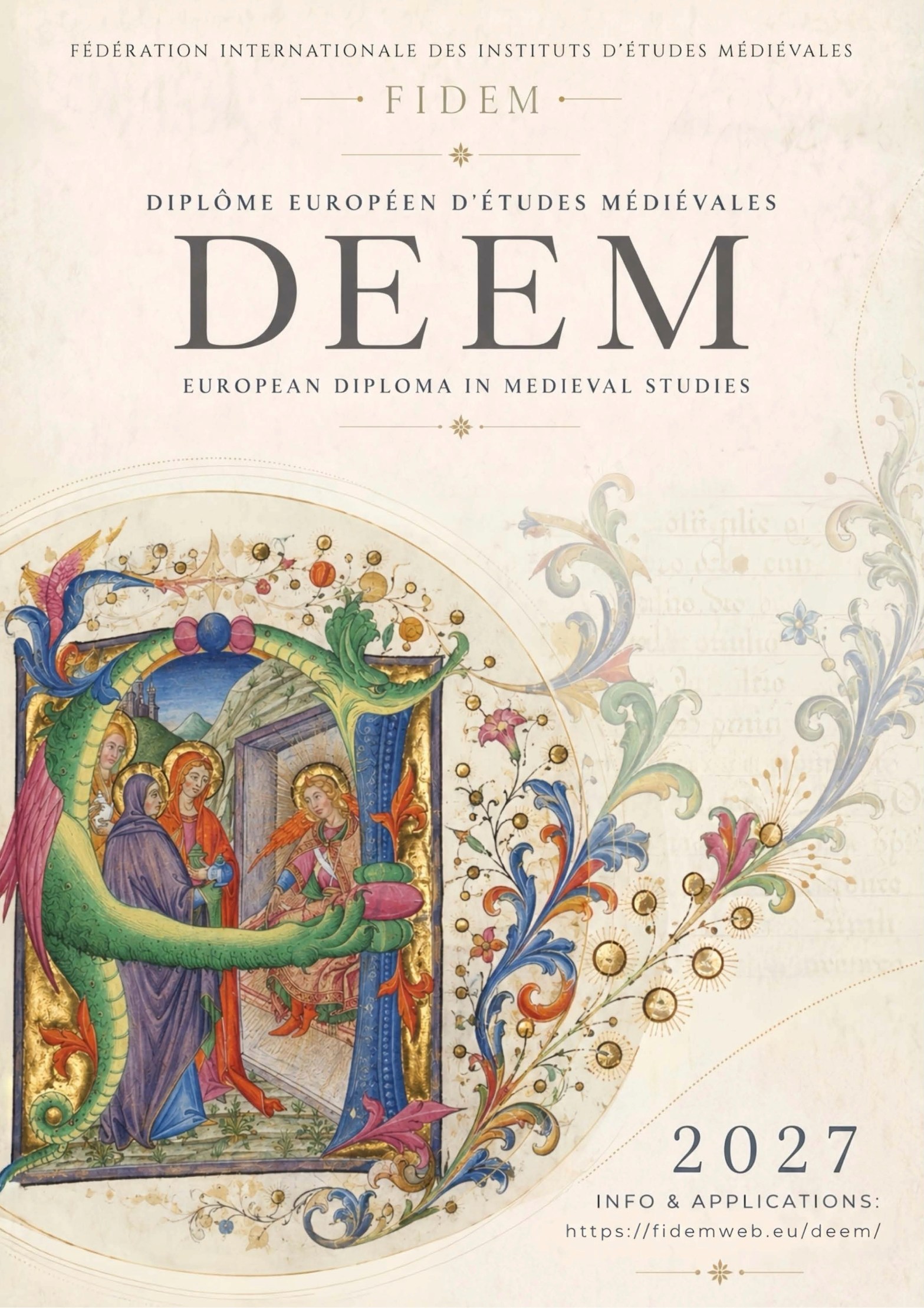
FIDEM (of which CODEX is a member) organises each year, in Rome, the Diploma in Medieval Studies (European Diploma for the Study of Medieval Latin Written Sources). The programme was established in Louvain-la-Neuve in 1991. More than twenty European and non- European universities are involved in this programme. The course provides methodological and practical training in disciplines central to the study and interpretation of Latin manuscripts and archival sources, including Classical and Medieval Latin, Palaeography, Codicology, Diplomatics, Textual Editing, and Digital Editing. All courses are taught in English. The teaching staff come from various countries with the aim of exposing Diploma students to a range of methodological approaches and current research perspectives. All courses will take place in an international setting at the Norwegian Institute in Rome and will include direct interaction with manuscript collections held in the numerous libraries and archives of Rome. All courses will be conducted in person. However, remote learning options will also be available for part of the course. A minimum of six participants is required for the course to be held. Attendance (both in-class and online) can be arranged in three formats: annual, modular and personalized. The general coordinator is Dr. Claudia Appolloni (KU Leuven – deem@fidemweb.org). For further information, please visit our DEEM Application page.
Annual programme (advanced course)
Classes begin on Monday, 18 January, with an optional Latin course.
The first mandatory course starts on Monday, 1 February, and the final course, Digital Editing, ends on 28 May.
All courses are scheduled from Monday to Friday, from 14:30 to 17:30.
Please note that the schedule is subject to change; any updates will be communicated in advance
Notes:
- Participation in all mandatory courses is required.
- To pass the course, students must submit all assignments as instructed by the professors
| Courses | Hours | Professors (TBC) | Dates |
|---|---|---|---|
| Blended | |||
| Latin (optional) | 30 | Carlos Prieto Espinosa Universitat de Barcelona (Spain) | 18 – 29 January |
| Medieval Latin | 30 | Wim Verbaal Universiteit Gent (Belgium) | 1 – 12 February |
| Palaeography I | 15 | Nina Sietis Università degli studi di Cassino | 15 – 19 February |
| Palaeography II | 30 | Nina Sietis Università degli studi di Cassino | 22 February – 5 March |
| Diplomatic I | 15 | Luca Polidoro Archivio di Stato di Roma. Scuola di Archivistica | 8 – 12 March |
| Diplomatic II | 15 | Daniel Piñol Alabart Universitat de Barcelona (Spain) | 15 – 19 March |
| Easter Holidays | 22 March – 4 April | ||
| Mandatory in Rome | |||
| Codicology I | 15 | Adrian Papahagi Universitatea Babeş-Bolyai, Cluj-Napoca (Romania) | 5 – 9 April |
| Codicology II | 30 | Marta Pavón Ramírez Instituto Español de Historia Eclesiástica (INE) | 12 – 23 April |
| Textual Editing I | 15 | Caterina Tarlazzi Università Ca’ Foscari Venezia | 26 – 30 April |
| Textual Editing II | 30 | Dominique Poirel IRHT – CNRS, Paris (France) | 3 – 14 May |
| Digital Editing I | 15 | Emmanuelle Kuhry IRHT – CNRS, Paris (France) | 17 – 21 May |
| Digital Editing II | 15 | Serena Crespi CESR – CNRS, Université de Tours | 24 – 28 May |
Module A (blended)
| Courses | Dates |
|---|---|
| Latin (optional) | 18 – 29 January |
| Medieval Latin | 1 – 12 February |
| Palaeography I | 15 – 19 February |
| Palaeography II | 22 February – 5 March |
| Diplomatic I | 8 – 12 March |
| Diplomatic II | 15 – 19 March |
Module B (mandatory in Rome)
| Courses | Dates |
|---|---|
| Codicology I | 5 – 9 April |
| Codicology II | 12 – 23 April |
| Textual Editing I | 26 – 30 April |
| Textual Editing II | 3 – 14 May |
| Digital Editing I | 17 – 21 May |
| Digital Editing II | 24 – 28 May |
Module C (personalised)
Palaeography (I and II)
Codicology (I and II)
One course chosen from the following options:
- Diplomatic (I and II)
- Textual Editing (I and II)
- Digital Editing (I and II)
(Selections to be made during registration)

